Types of Scaffolding Explained: Uses, Safety and Load Ratings
Scaffolding types are not interchangeable. Each system — from traditional tube and coupler to rosette-based modular systems like ringlock — has its own connection geometry, load capacity, labour requirement and purchase cost. Choosing the wrong type costs money on day one and can create a safety problem on day two.
This guide explains the six scaffolding types that Sino East Steel Group manufactures and exports from Tianjin, China: tube and coupler, frame, kwikstage, cuplock, ringlock and wedge lock (star lock). For each type we cover how the connection works, where it is used, real load data from our product pages and in-house load tests, and the price and container-loading figures you need for budgeting. We then explain EN 12811 load classes, safety factors, galvanizing and the documents you should request from any supplier.
In this guide
1. Tube and Coupler Scaffolding
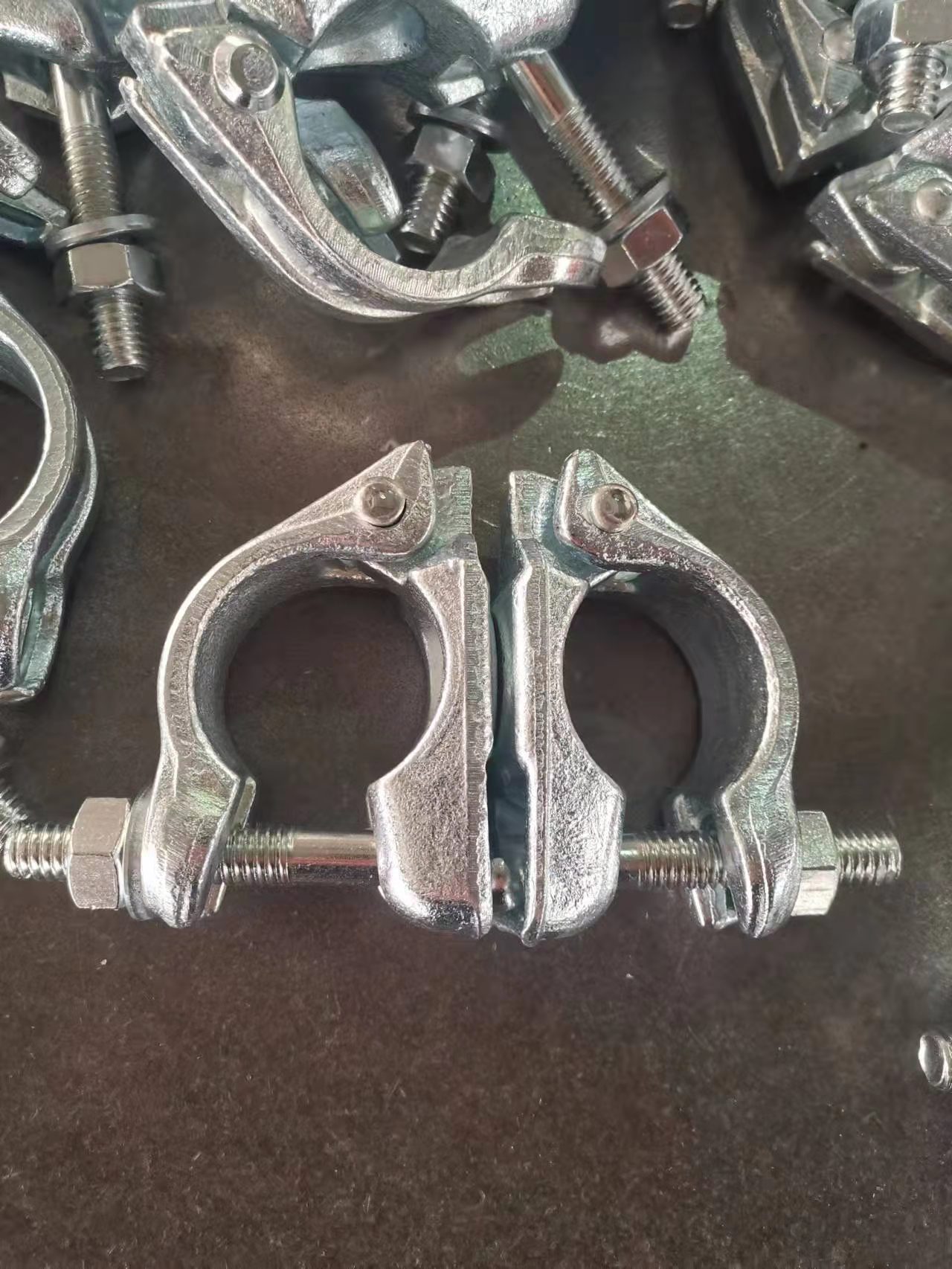
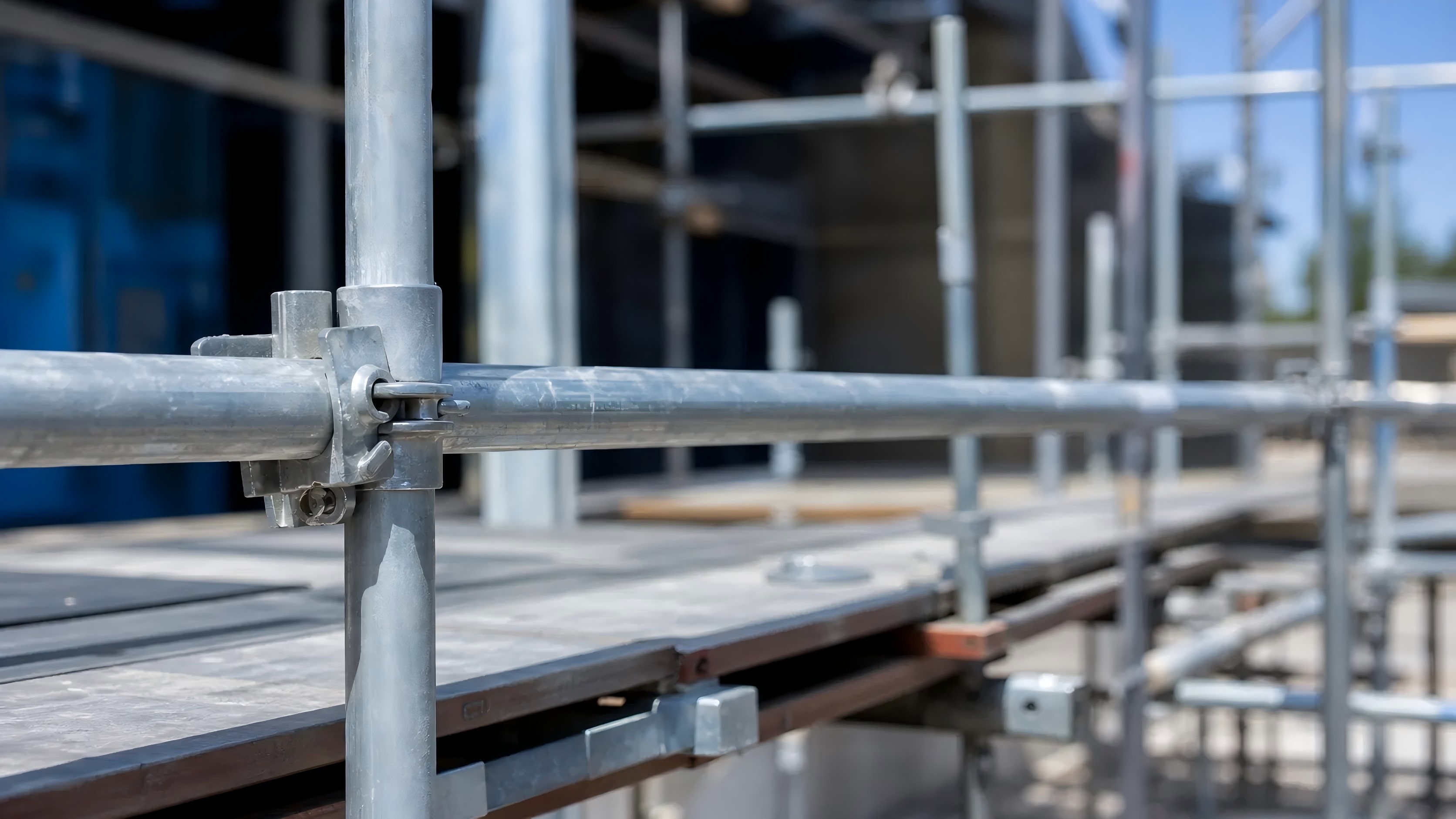
Tube and coupler (also called tube and clamp) scaffolding is the oldest and most flexible access system still in volume use. Steel tubes, normally 48.3 mm outside diameter, are joined by drop-forged couplers — right-angle couplers, swivel couplers and putlog couplers — into any geometry the facade requires. Because every joint is made on site with a spanner, the system adapts to curved facades, tank exteriors, pipe racks and chimney work where modular bay dimensions do not fit.
Where it is used: maintenance and shutdown work in plants, irregular building geometries, and projects that already own tube stock and couplers. Where it loses: labour. Every joint must be tightened and inspected, so erection is several times slower than a modular system. Most contractors now keep tube and coupler only for the difficult geometry and run the straight runs on modular systems. See our scaffolding couplers and scaffolding pipes pages for grades and sizes.
2. Frame (H-Frame / A-Frame) Scaffolding

Frame scaffolding is built from pre-welded tubular frames that lock together with cross braces and joint pins — no measuring and almost no loose fittings. The main frame (A-frame or walk-through frame) leaves an opening for workers to pass through at each lift; H-frames use horizontal cross bars for extra rigidity. Sino East manufactures frames in the standard export widths of 762 mm, 914 mm and 1219 mm, with heights of 1530 mm, 1700 mm and 1930 mm, from Q235/Q345 tube of OD 42.7 mm with 1.8–2.5 mm wall thickness.
Where it is used: facade work, plastering, painting, masonry and interior fit-out up to mid-rise height, where speed and simplicity matter more than heavy duty ratings. A complete system adds metal decks (210/240/250 mm widths), guardrails, ladder frames, screw jacks and castor wheels for mobile towers. It is manufactured to BS 1139 and EN 12810 practice. Full dimension tables are on our frame scaffolding and walk-through frame pages.
3. Cuplock Scaffolding
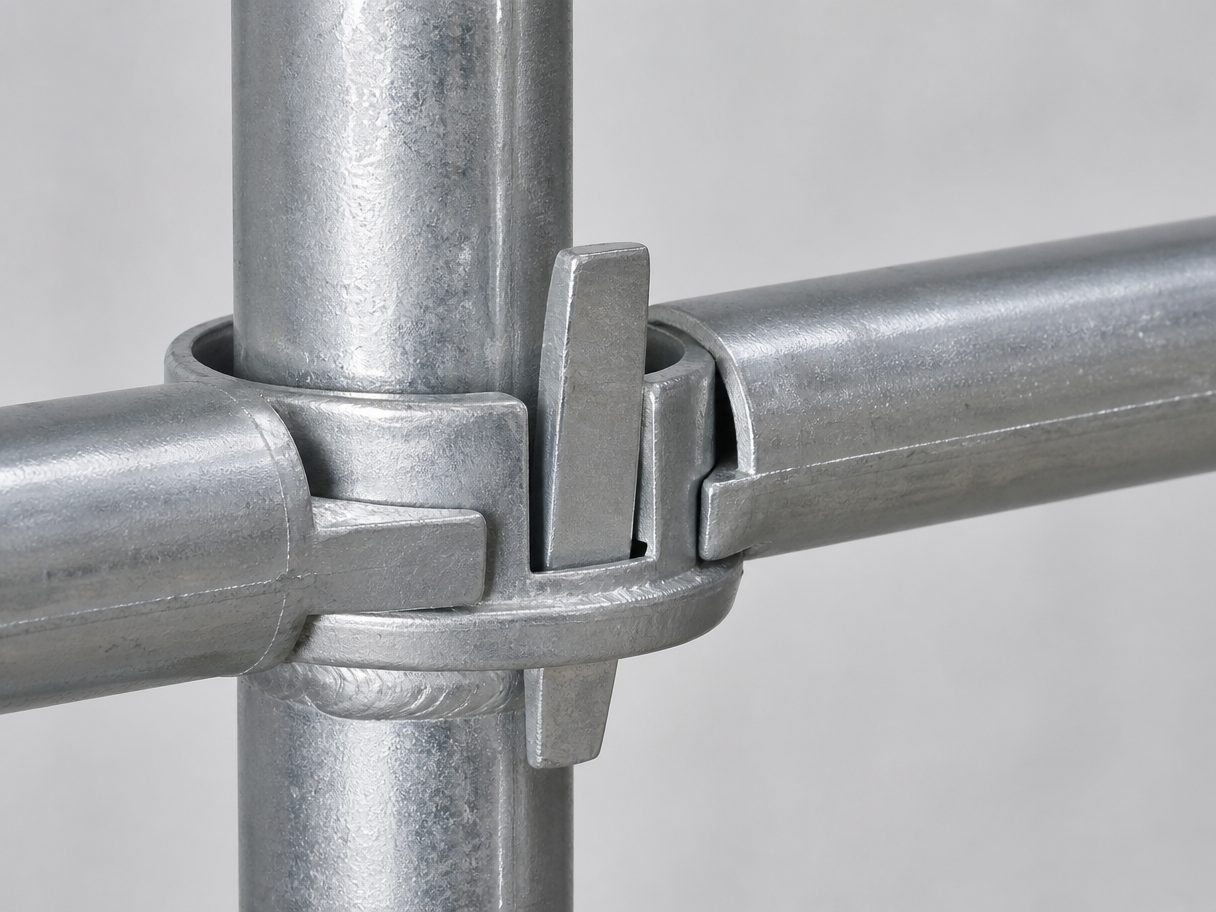
Cuplock uses a cup-and-blade connection: a bottom cup is welded to the vertical standard at 500 mm or 1,000 mm intervals, a captive top cup slides on the same tube, and each ledger ends in a forged blade. The blade ends drop into the bottom cup, the top cup slides down, and a single hammer blow locks up to 4 horizontal connections per node. Invented by SGB in the 1970s, it remains the most cost-effective modular system for general construction up to about 30 m height.
Load and specification data (from our cuplock product page): standards are Q235 (S235 equivalent) at 48.3 mm OD × 3.25 mm wall; ledgers are 48.3 mm × 2.5 mm with forged blades and a safe working load up to 16 kN. In-house load tests show a 3-bay tower ULS of 101.62 kN, giving a safe working load (SWL) of 33.87 kN at a 3:1 safety factor, and a 3 m standard ULS of 153.47 kN → SWL 51.16 kN. A single standard carries roughly 60 kN ultimate axial capacity; slab-shoring grids of 1.2–1.8 m support slab loads up to 6 kN/m².
Where it is used: facade scaffolding, concrete slab formwork shoring, birdcage scaffolds, maintenance access and stair towers across the Middle East, Southeast Asia and Africa. Factory-direct price runs USD 500–600 per ton FOB (roughly 20% below ringlock), and cuplock packs 25–28 tons per 20ft container — the densest of any modular system. More in our cuplock product page, the cuplock buying guide, and the Vietnam-focused cuplock for Vietnam guide.
4. Ringlock (Rosette) Scaffolding
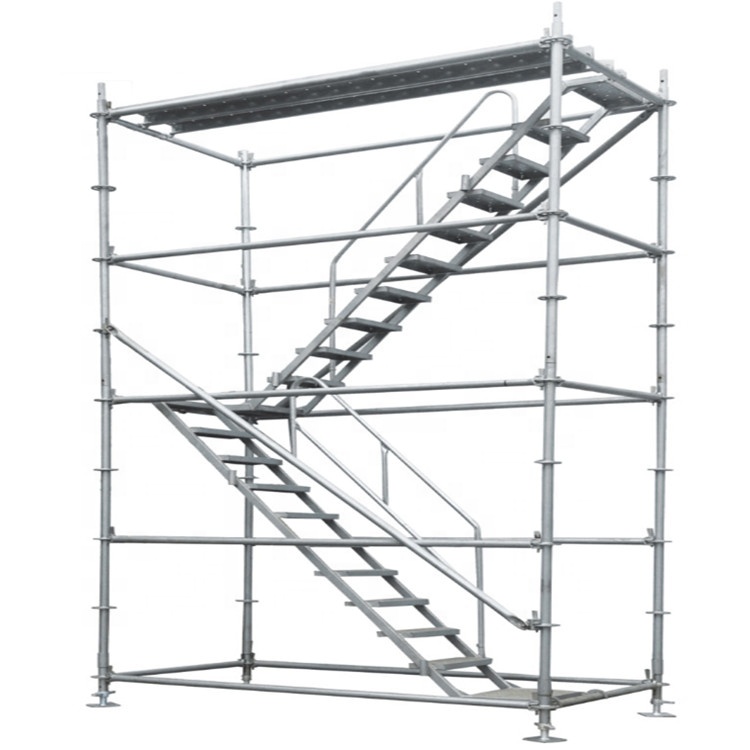
Ringlock (rosette scaffolding) is the most advanced modular system in common export. A circular rosette is welded to the vertical standard every 500 mm, and each rosette accepts up to 8 connections per node — 4 horizontal and 4 diagonal — so ledgers, transoms and braces can leave the node at 45° increments. Wedge-head ledgers lock with one hammer blow; there are no loose cups or bolts. Standards are manufactured from Q345 structural steel at 48.3 mm OD × 3.25 mm, hot-dip galvanized to 80 µm minimum.
Load data (from our ringlock product page): Q345 standards provide 40–60 kN safe working load per leg at standard lift heights, covering EN 12811 duty Class 3 through Class 6 (2.0–6.0 kN/m²). A single 48.3 mm × 3.2 mm S355 ringlock standard delivers approximately 80 kN ultimate vertical leg capacity — about 33% higher than cuplock at the same tube size. Because the geometry is standardised (rosette pitch, tube OD, wedge profile), ringlock from Sino East is dimensionally compatible with Layher Allround, Peri Up, Altrad and similar systems, so mixed fleets can share components.
Where it is used: industrial plants, oil and gas facilities, shipyards, bridge construction, high-rise buildings and heavy concrete shoring — anything with complex geometry or high duty classes. Factory-direct price is typically USD 600–750 per ton FOB. See the ringlock product page, the complete ringlock buying guide and the ringlock components, dimensions and load capacity guide.
5. Kwikstage (Wedge-Lock V-Press) Scaffolding
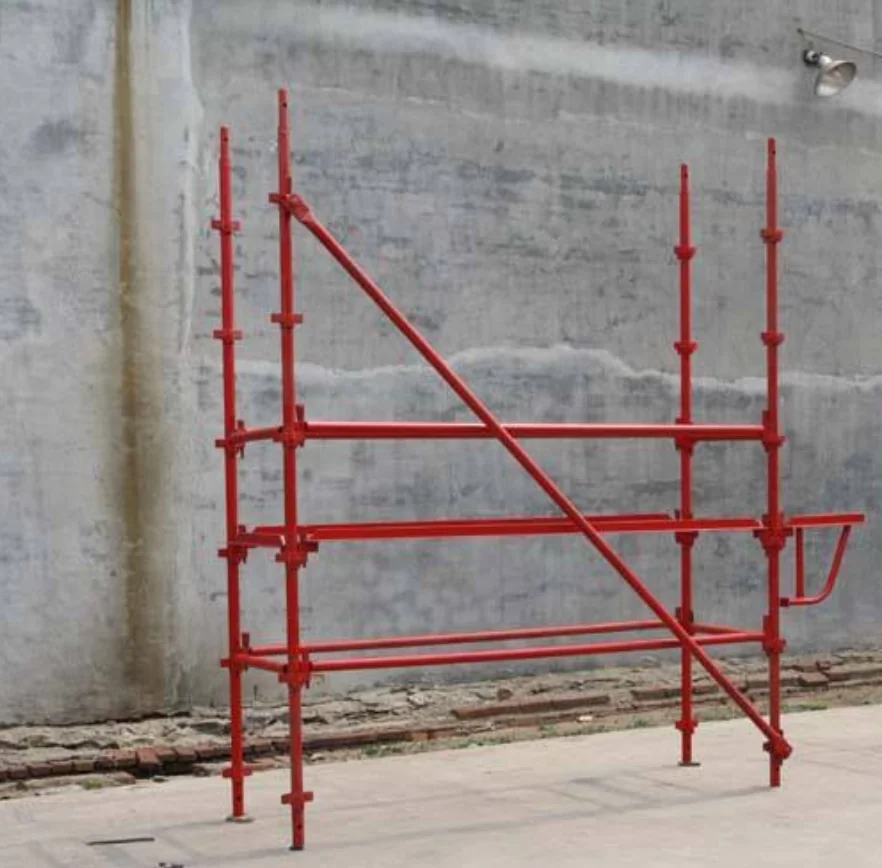
Kwikstage is the classic wedge-lock system of Australia, the UK and South Africa. Its standards carry V-shaped pressings at regular intervals; ledgers and transoms end in forged wedge connectors that slide into the pressing and lock with a hammer blow. The connection is self-tightening — the heavier the load, the tighter the wedge grips — and assembly runs 40–50% faster than tube and coupler. Sino East manufactures all three regional variants: Australian (AS/NZS 1576, 48.3 mm × 3.2 mm or 4.0 mm wall, thumb-wedge pin), South African (SANS 10085, wedge-C mechanism, 48.3 mm × 3.35 mm) and UK/European (EN 12810 / BS 1139, standard V-press, 48.3 mm × 3.25 mm, 0.5–3.0 m lengths).
Kwikstage is rated for the EN 12811 Class 2–4 range and is the lowest-cost-per-ton modular option for residential and commercial work, with a compact V-press design that packs roughly 15–20% more components per container than ringlock. Finish is hot-dip galvanized at 80 µm minimum (20+ years outdoor service). See the kwikstage product page and the kwikstage buying guide.
6. Wedge Lock / Star Lock Scaffolding
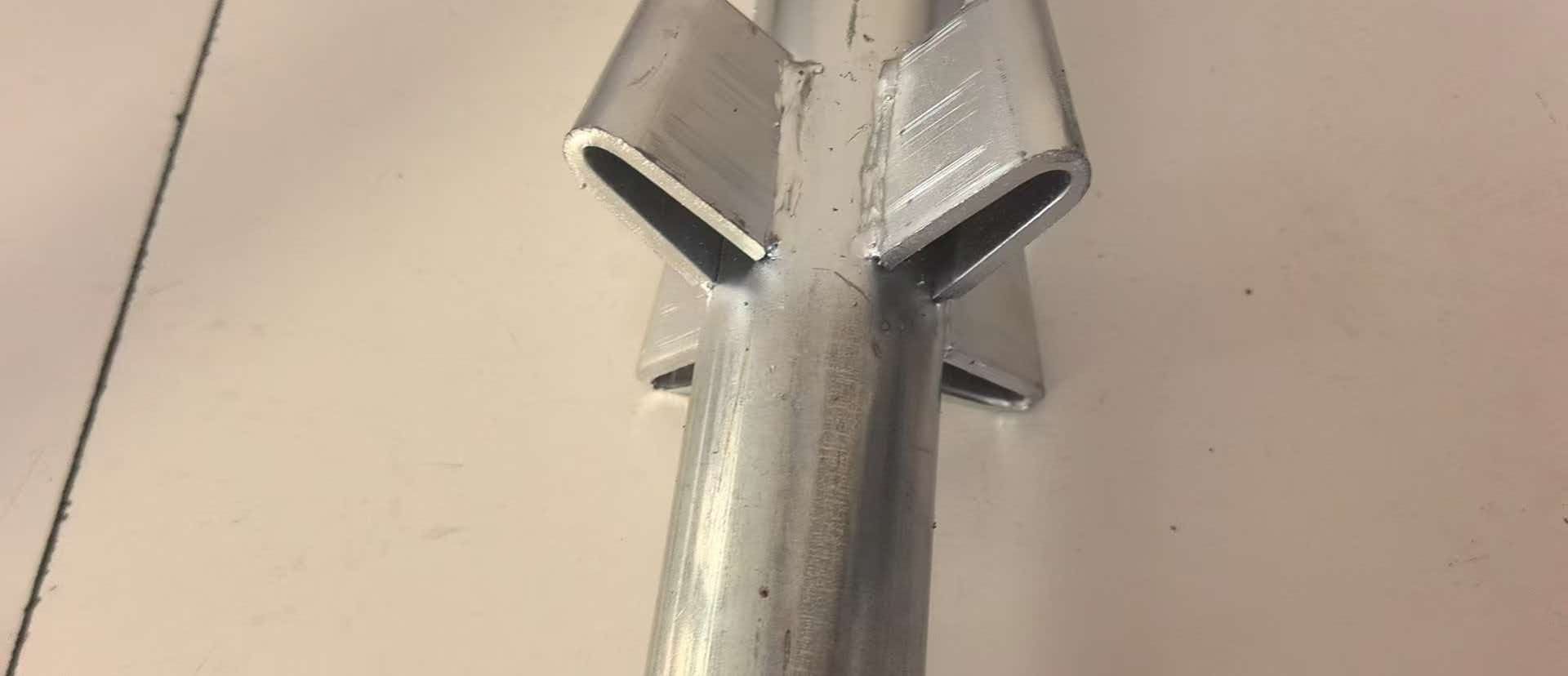
Wedge lock — called giàn giáo nêm (wedge scaffolding) or khóa nêm (wedge-lock scaffolding) in Vietnam, and star lock in some markets — is the rosette-era system that has become the default choice for new facade work in Vietnam. Standards are typically S355/Q355 steel at 48.3 mm OD × 3.2 mm with node plates welded at 500 mm spacing standard (300 mm for heavy duty), and every ledger ends in a forged wedge blade that locks into the node with a hammer. Unlike ringlock, which uses a separate wedge pin dropped through the rosette, most wedge lock ledgers carry the wedge forged on the end — so there is no loose pin to lose on site, and the fully-driven wedge is visually verifiable by inspectors.
With 500 mm node spacing and 2.0 m ledger spans, an S355 wedge lock standard carries roughly 6.0 kN/m² working load on a standard duty platform, with hot-dip galvanizing to EN ISO 1461 at 55–85 µm for Vietnam’s coastal humidity. Factory-direct price runs USD 750–950 per ton FOB depending on steel grade and coating, with a 40HQ container loading about 26–28 tons. See our wedge lock product page and the wedge lock for Vietnam guide for full specifications.
How the Scaffolding Types Compare
The table below summarises the six types using data from the Sino East product pages and published guides referenced above.
| Type | Connection | Node | Steel | Typical price (FOB) | Best-fit use |
|---|---|---|---|---|---|
| Tube & coupler | Drop-forged couplers, spanner-tightened | Any angle | Q235/Q345 tube | Component-based | Irregular geometry, plant maintenance |
| Frame | Cross braces + joint pins | 4 | Q235/Q345, OD 42.7 | Quote-based | Facades, interior fit-out, low/mid-rise |
| Kwikstage | V-press wedge | 4 | Q235/Q345, OD 48.3 | Lowest per ton (Q235) | Residential & commercial (AU/UK/SA) |
| Cuplock | Cup-and-blade | 4 | Q235, OD 48.3 | USD 500–600/t | General construction ≤30 m, slab formwork |
| Ringlock | Rosette + wedge pin | 8 | Q345, OD 48.3 | USD 600–750/t | Industrial, high-rise, complex geometry |
| Wedge lock | Node plate + forged wedge | 4–8 | S355/Q355, OD 48.3 | USD 750–950/t | Facade & formwork (Vietnam/Australia) |
Load Ratings, Safety Factors and Standards
Whatever the type, the load figures that matter are expressed against a standard. In Europe and most export markets that standard is EN 12811-1, which defines duty classes by the platform load the scaffold is designed for:
| EN 12811 duty class | Platform load | Typical use |
|---|---|---|
| Class 2 | 1.5 kN/m² | Inspection, light maintenance |
| Class 3 | 2.0 kN/m² | General construction, plastering |
| Class 4 | 3.0 kN/m² | Brickwork, material storage |
| Class 5 | 4.5 kN/m² | Concrete shoring, industrial |
| Class 6 | 6.0 kN/m² | Heavy industrial, bridge work |
Safety factor practice. Sino East states load ratings as ULS (ultimate limit state) tested values converted to SWL (safe working load) at a 3:1 safety factor. Example: the cuplock 3-bay tower test gives ULS 101.62 kN, so the declared SWL is 33.87 kN. When a supplier gives you only a single number, ask whether it is ultimate or safe working load — the difference is a factor of three.
Standards and certification. Ringlock, cuplock and kwikstage are manufactured to EN 12810 / EN 12811; cuplock, frame and kwikstage also follow BS 1139; ringlock and kwikstage add AS/NZS 1576 for Australia/New Zealand, and the South African kwikstage variant follows SANS 10085. The Sino East factory in Tianjin holds CE EN 1090-1 (EXC2), ISO 3834-2 welding quality and ISO 9001:2015, and every shipment includes EN 10204 Type 3.1 mill test certificates plus batch load-test reports. View our certificates.
Coating and Service Life
For export scaffolding the finish decision is usually made before the price decision. Hot-dip galvanizing (HDG) to EN ISO 1461 / ASTM A123 at 80 µm minimum is the standard export finish across ringlock, cuplock and kwikstage. HDG ringlock lasts 15–25 years inland and 10–15 years in coastal environments; kwikstage HDG is quoted at 20+ years outdoor service. Painted finishes cost less up front but typically last 2–10 years and need periodic touch-up, which is why painted cuplock is mainly chosen for dry Gulf-climate projects while coastal and rental-fleet buyers specify HDG. Frame systems add two further options — pre-galvanized tube and powder coating — for buyers matching an existing fleet colour.
How to Choose: Checklist Before You Buy
- Match the node to the work: straight facades and slab grids run fine on 4-way systems (cuplock, kwikstage); complex geometry, heavy shoring and high-rise favour 8-way ringlock or wedge lock with diagonals;
- Confirm the duty class you must certify to: EN 12811 Class 2–4 covers most access work; Class 5–6 projects need Q345/S355 standards and documented load tables;
- Pin the steel grade and coating in the contract: Q235 vs S355 changes capacity and price; HDG thickness (55–85 µm) should be written down with the coating certificate;
- Ask for the load test behind the numbers: ULS vs SWL, the bay size tested, and the 3:1 safety factor;
- Request documentation up front: EN 12810/12811 or BS 1139 compliance, CE EN 1090-1, ISO 3834-2, EN 10204 Type 3.1 mill test certificates, load test reports;
- Plan the container mix with the supplier: standards, ledgers, braces, planks and jacks in one mix. Cuplock packs 25–28 t/20ft, ringlock 22–26 t/20ft, kwikstage 22–28 t/20ft, and a 40HQ of wedge lock takes about 26–28 t;
- Check lead time and inspection: production is typically 15–25 days after deposit, with SGS/BV third-party inspection available before loading.
Frequently Asked Questions About Scaffolding Types
Which type of scaffolding has the highest load capacity?
Ringlock. Its 8-way rosette node and Q345/S355 standards provide 40–60 kN safe working load per leg (approximately 80 kN ultimate), about 33% higher than cuplock at the same tube size, covering EN 12811 Class 3–6. Cuplock standards carry roughly 60 kN ultimate; kwikstage and frame systems are specified for the lighter Class 2–4 range.
What does EN 12811 load class 4 mean?
EN 12811-1 classifies scaffolds by design platform load. Class 4 means the platform is designed for 3.0 kN/m² (brickwork and material storage duty). Class 2 is 1.5, Class 3 is 2.0, Class 5 is 4.5 and Class 6 is 6.0 kN/m².
Ringlock vs cuplock vs kwikstage: which is the cheapest?
On price per ton FOB, kwikstage (Q235) is the lowest-cost modular option, cuplock runs about USD 500–600 per ton, and ringlock USD 600–750 per ton. Cuplock additionally packs the most tons per container (25–28 t/20ft). The cheapest system is only the right one if its duty class covers your project.
Is galvanized scaffolding better than painted?
For export and rental fleets, yes. Hot-dip galvanizing to EN ISO 1461 at 80 µm protects against rust for 15–25 years inland and 10–15 years in coastal environments, while painted finishes last about 2–10 years and need touch-ups. Painted finish only makes sense in dry climates on a fixed project budget.
Can I mix components from different scaffolding systems?
No — the node connections are physically different, so cuplock, kwikstage, ringlock and wedge lock components are not interchangeable. The exception is dimensional compatibility within one family: ringlock from different manufacturers (Layher, Peri, Altrad, Sino East) shares rosette pitch and tube OD. You can also standardise bay dimensions across fleets so ledgers and planks are shared.
What documents should a scaffolding supplier provide?
EN 12810/12811 (or BS 1139, AS/NZS 1576) compliance statements, CE EN 1090-1 and ISO 3834-2 certificates, EN 10204 Type 3.1 mill test certificates with heat-number traceability, the galvanizing certificate with coating thickness readings, and the load test report for the exact standard lengths you are buying.
Request a Quotation for Your Scaffolding Project
Tell us the system type, quantity in tons, steel grade and coating, and your destination port — our engineers reply within 24 hours with factory-direct pricing, load documentation and a container loading plan.
Also reachable on Zalo at +86 186 2208 8833, or e-mail [email protected] — engineers reply within 24 hours.
Get a Quote & Price List
Tell us the product, quantity and destination port — a sales engineer replies within 24 hours.