Cuplock Scaffolding for Vietnam: The Complete 2026 Buyer's Guide
Cuplock scaffolding — known in Vietnam as giàn giáo chén or giàn giáo khóa chén (cup-lock scaffolding) — is the most cost-effective modular system for general construction up to 30 m, and it is becoming a common sight on Vietnamese sites from Ho Chi Minh City to Hai Phong. This guide explains what cuplock is, how the cup-and-blade joint works, how it compares with the wedge lock and ringlock systems Vietnamese contractors already know, which standards and documents to request, and what a realistic budget and delivery plan look like when importing from China in 2026.
If you are evaluating giàn giáo nêm (wedge lock) instead, read our separate Wedge Lock Scaffolding for Vietnam guide — this article focuses specifically on cuplock and where it fits in a Vietnamese project.
Why cuplock scaffolding is growing across Vietnam
Vietnam's construction pipeline — residential towers, industrial zones, warehouses and expressway-related works — runs on fast, repeatable access systems. Traditional tube-and-coupler scaffolds are labor-heavy: every joint is a loose fitting that must be tightened and checked. Cuplock replaces that labor with a pre-welded node. Each vertical standard carries welded cups at 500 mm or 1,000 mm intervals, and one hammer blow on the sliding top cup locks up to four ledgers or transoms at the same time. No bolts, no loose fittings, no special tools.
For Vietnamese contractors and rental companies that already run ringlock or wedge lock fleets, cuplock is usually added as the economic workhorse: it costs roughly 20% less per ton than ringlock while carrying the same general-construction duties. That price advantage, combined with dense container packing (25–28 tons per 20ft container — the best of any modular system), makes it a frequent first import for Vietnamese buyers testing the market.
Where cuplock is used on Vietnamese construction sites
Cuplock earns its place in five recurring site situations across Vietnam, from the southern industrial belt around Binh Duong and Dong Nai to the northern growth corridor around Hanoi and Bac Ninh:
- Facade scaffolding for commercial buildings, apartment towers and renovation work — the orthogonal 4-way grid matches straight facades, and platforms, ladders and edge protection all come from the same cuplock inventory;
- Concrete slab formwork shoring — standards at 1.2–1.8 m grids with U-head jacks support slab loads up to 6 kN/m², and a cuplock drop-head option allows early stripping so formwork turns faster on tight schedules;
- Birdcage scaffolds in large interior spaces — auditoriums, atriums, and industrial halls where a dense, stable grid of standards carries working decks over wide floor areas;
- Maintenance access for plant turnarounds, equipment servicing and facility inspection — quick to erect, easy to reconfigure between work fronts;
- Stair access towers and mobile towers — dedicated stair towers with handrails for daily worker access, plus castor-wheel towers for interior finishing.
One climate note matters specifically for Vietnam. The default finish is hot-dip galvanizing at 80 µm (EN ISO 1461 / ASTM A123), which suits the coastal humidity of Da Nang, Hai Phong and the Mekong Delta and protects rental fleets for 15+ years. In drier, inland conditions a painted finish cuts the initial cost; many Vietnamese rental companies still choose HDG because a single coastal project justifies the difference. If you plan to rent the fleet across regions, specify HDG and keep the coating certificate on file.
What is cuplock scaffolding (giàn giáo chén)? How the cup-and-blade joint works
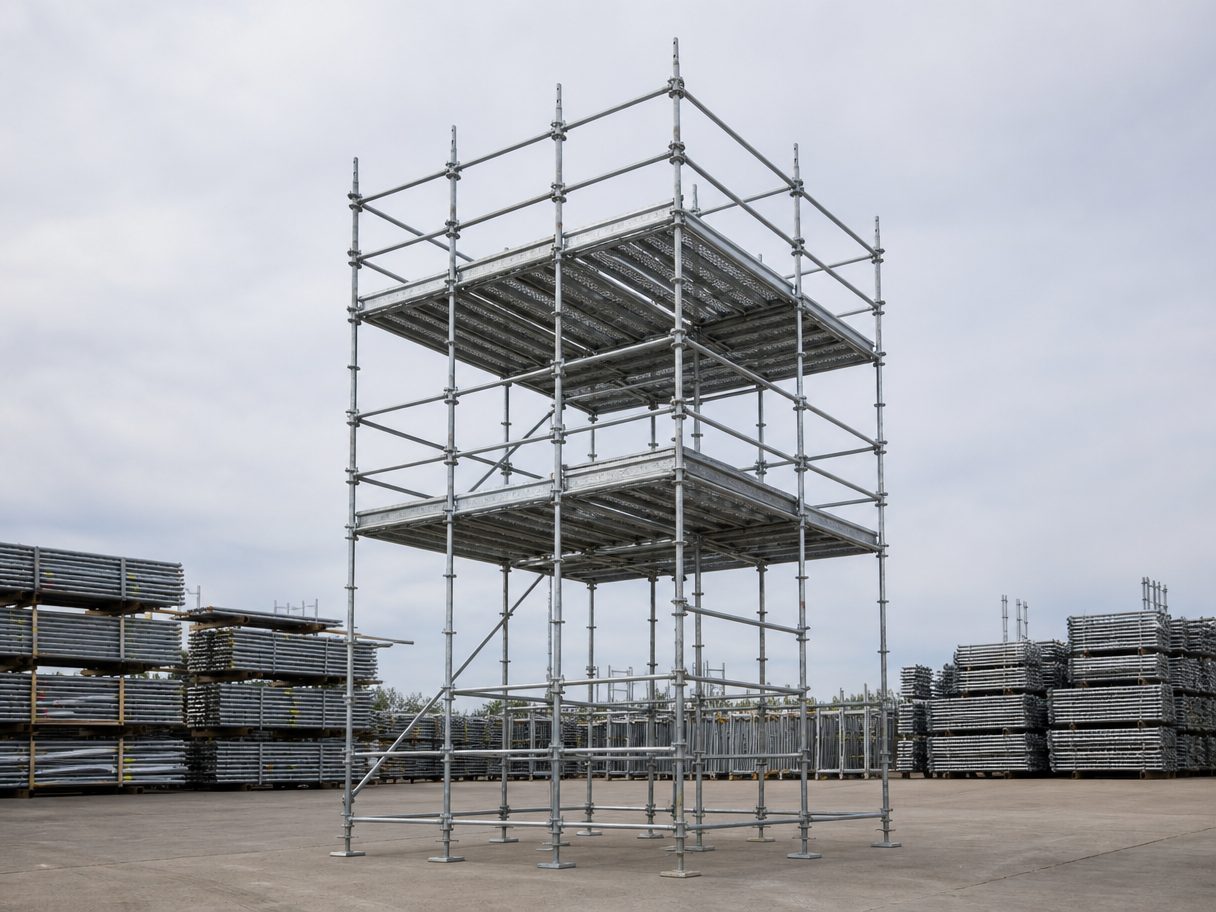
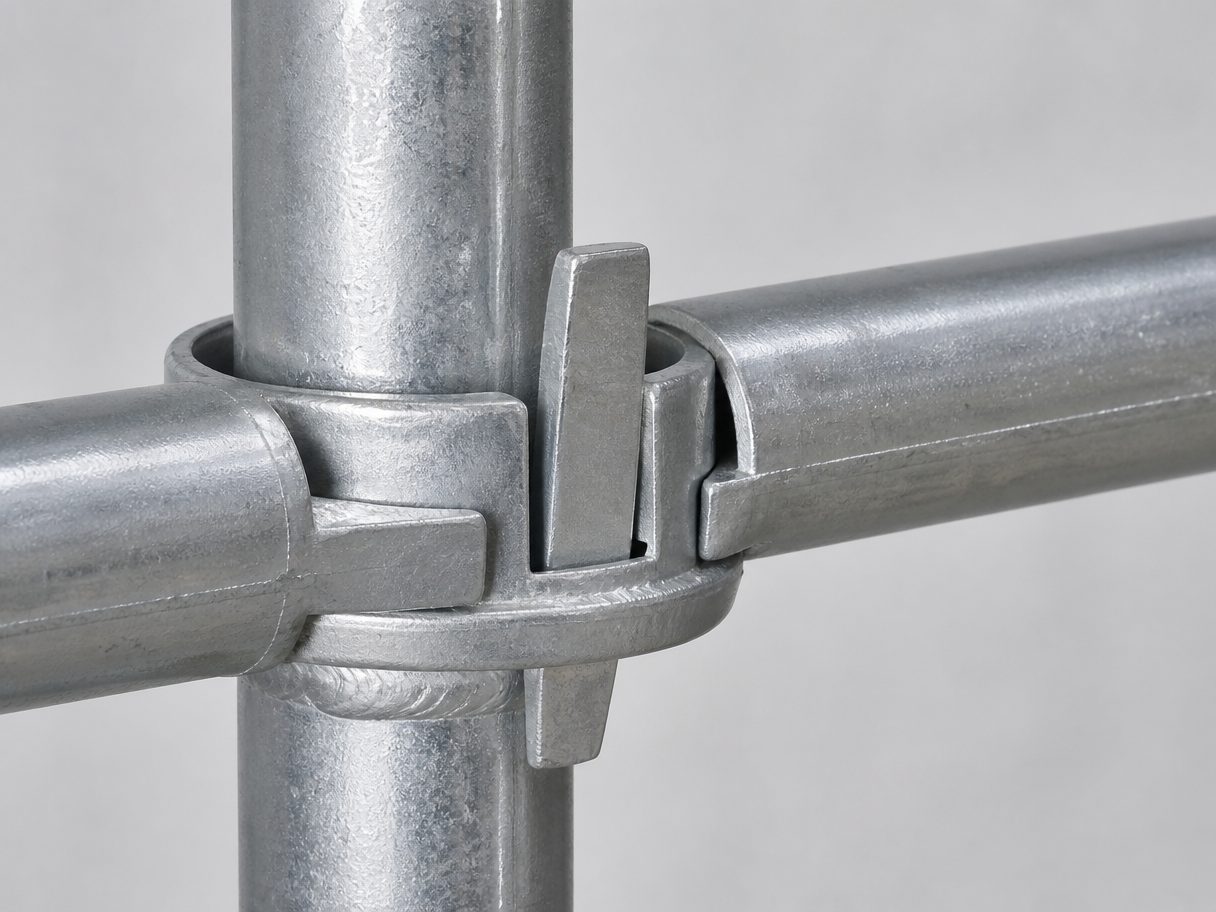
The cuplock system was invented by SGB in the 1970s and has been field-proven on millions of sites since. Its core is the cup-and-blade connection:
- A bottom cup is welded to the vertical standard at each node point;
- A sliding top cup travels on the same standard and is captive — it can never be lost or dropped, a real safety and inventory advantage;
- Each horizontal ledger or transom ends in a forged blade;
- The blade ends seat into the bottom cup, the top cup slides down over them, and a hammer blow locks the whole node — up to 4 horizontal connections per node.
The 4-way node suits the orthogonal grids used on straight facades, rectangular floor slabs and slab formwork shoring — which is precisely what most Vietnamese general-construction projects need. When diagonals are required, a swivel-clamp diagonal brace stabilizes the bay laterally.
Cuplock vs wedge lock vs ringlock: which fits a Vietnam project?
Vietnamese contractors often compare three rosette-era modular systems. The short answer: wedge lock and cuplock dominate different budgets, and ringlock leads on heavy or complex geometry. The table below summarizes the differences a Vietnamese buyer should weigh before choosing.
| Feature | Cuplock (cup-and-blade) | Wedge lock (rosette+wedge) | Ringlock (rosette+wedge) |
|---|---|---|---|
| Connections per node | 4 (horizontal) | 4–8 | 8 (incl. diagonals) |
| Locking action | Cup + hammered top cup | Wedge into rosette slot | Wedge pin into rosette |
| Typical cost per ton (FOB) | USD 500–600 | USD 550–680 | USD 600–750 |
| Standard steel grade | Q235 (S355/Q345 optional) | S355/Q345 | Q345/S355 |
| Typical leg capacity | ~60 kN (standard) | Moderate | ~80 kN |
| Best application | General construction ≤30 m, slab formwork, straight facades | General construction, popular in Vietnam/Australia | Heavy industrial, complex geometry, Oil & Gas |
| Container load (20ft) | 25–28 tons | ~24–26 tons | 22–26 tons |
Read more in our complete ringlock buying guide and the ringlock load-capacity and dimension guide. For slab formwork and straight facade access on a budget, cuplock is normally the most economical choice; for complex industrial structures, ringlock earns its premium.
TCVN practice, EN 12810 and galvanizing: what compliance documents to request
Vietnam does not have a cuplock-specific national product standard, so Vietnamese projects follow TCVN practice for temporary works and accept internationally certified systems. A cuplock supplier for the Vietnamese market should be able to present, without being chased:
- EN 12810 / EN 12811 certification for prefabricated facade scaffolds and temporary works equipment;
- CE EN 1090-1 (EXC2) execution certification for structural steel, plus ISO 3834-2 welding quality and ISO 9001:2015;
- EN 10204 Type 3.1 mill test certificates with full batch traceability for every shipment;
- Hot-dip galvanizing to EN ISO 1461 / ASTM A123 at 80 µm minimum — critical for Vietnam's coastal humidity and for rental fleets that want 15+ years of service;
- Third-party inspection (SGS or BV) at the factory before loading, if your contract requires it;
- For Southeast Asian projects, CIDB Malaysia approval is available — useful for contractors working across borders.
Do not accept a quotation that offers only a general "ISO certified" line. Ask for the load test report behind the numbers, the 3.1 MTC for the steel grade, and the galvanizing certificate with coating thickness readings. Any of our shipments can include all three.
Cuplock specifications and load data you can budget against
| Steel grade | Q235 (S235 equivalent); Q345/S355 available for heavy-duty |
| Standard tube | 48.3 mm OD × 3.25 mm wall, lengths 0.5–3.0 m, cup spacing 500 mm (1,000 mm optional) |
| Ledger tube | 48.3 mm OD × 2.5 mm wall, forged blades, lengths 0.6–3.0 m, SWL up to 16 kN |
| Surface finish | Hot-dip galvanized 80 µm (EN ISO 1461 / ASTM A123); painted option for dry climates |
| 3-bay tower load test | ULS 101.62 kN → SWL 33.87 kN (3:1 safety factor) |
| 3 m standard load test | ULS 153.47 kN → SWL 51.16 kN |
| Base jack SWL | 35.33 kN (400 mm extension) to 57.67 kN (100 mm) |
| Slab shoring grids | 1.2–1.8 m grids, slab loads up to 6 kN/m²; light-duty 1.8 m × 1.8 m bays at 2 kN/m² |
| Certifications | EN 12810, EN 12811, BS 1139, CE EN 1090-1, ISO 9001:2015, ISO 3834-2 |
Component weights matter when you plan a container. A typical mix of a 1.0 m standard (6.31 kg), a 2.0 m standard (11.82 kg), a 2.0 m ledger (7.54 kg) and a 2.5 m ledger (9.35 kg) lets you calculate deck coverage and freight in one pass. Full weight tables are published on the cuplock scaffolding product page.
Cost, MOQ and shipping from Tianjin to Vietnam in 2026
Three numbers frame every cuplock budget conversation with a Vietnamese buyer:
- Price: factory-direct cuplock runs USD 500–600 per ton FOB Tianjin (Q235, HDG), roughly 20% below ringlock and about 15–20% below wedge lock with the same coating;
- Container density: 25–28 tons per 20ft container with a mixed component plan — the densest packing of any modular system, which cuts freight cost per ton;
- Delivery: production lead time 15–25 days after deposit, then roughly 10–14 days sea freight from Tianjin to Ho Chi Minh City (Cat Lai port) and 8–12 days to Hai Phong, depending on the sailing schedule.
Standard MOQ is one 20ft container; trial orders from 5 tons by LCL can be arranged for first-time Vietnamese buyers who want to test the product before committing to a full container. If you are comparing with wedge lock, note that cuplock gives the same 20–30 day order cycle but a lower per-ton price — the trade-off is 4-way nodes instead of 8-way, which rarely matters on standard facades and slab grids.
Checklist before you place a cuplock order for Vietnam
- Confirm the node standard: 500 mm cup spacing is the default; 1,000 mm exists for lighter duties — specify which one matches your existing fleet or project drawings;
- Choose blade type consciously: drop-forged blades for rental fleets and frequent cycles; pressed blades save 15–20% for single-project deployment;
- Pin the coating: 80 µm HDG to EN ISO 1461 for coastal Vietnam; ask for the coating certificate, not just the word "galvanized";
- Request load documentation up front: EN 12810 compliance, 3.1 MTC, and the load test report for the exact standard lengths you buy;
- Plan the mix with the supplier: standards, ledgers, transoms, base jacks and planks in one container mix maximizes tons-per-TEU and minimizes re-orders;
- Arrange third-party inspection (SGS/BV) if your main contractor requires it — standard practice for Vietnamese EPC and government-linked projects.
Frequently asked questions about cuplock for Vietnam
What is cuplock scaffolding called in Vietnam?
Vietnamese contractors call it giàn giáo chén (cup scaffold) or giàn giáo khóa chén (cup-lock scaffold), referring to the welded cup on the vertical standard. The English term cuplock or cup-lock is also widely understood in tenders and import documentation.
Is cuplock scaffolding compliant with Vietnamese standards?
Vietnam applies TCVN practice for temporary works and accepts internationally certified systems. Cuplock manufactured to EN 12810 / EN 12811 and BS 1139, with CE EN 1090-1 and ISO 3834-2, is the norm accepted on Vietnamese projects. Request the certificates and 3.1 MTC with your order.
How much load can cuplock scaffolding carry?
A single 48.3 × 3.25 mm cuplock standard delivers roughly 60 kN ultimate axial capacity; our 3 m standard load test shows ULS 153.47 kN → SWL 51.16 kN at a 3:1 safety factor. Light-duty 1.8 m × 1.8 m bays support 2 kN/m² per EN 12811, and slab-shoring grids of 1.2–1.8 m handle up to 6 kN/m².
Cuplock or wedge lock — which should a Vietnamese contractor buy first?
For slab formwork, straight facades and general construction on a budget, cuplock costs less per ton and packs more tons per container. If your work mix includes star-lock style rosette projects or you already run a wedge lock fleet, standardizing on wedge lock avoids dual inventory. Sino East manufactures both — request samples of each and compare on your own site before committing.
What is the minimum order and how long does delivery to Vietnam take?
Standard MOQ is one 20ft container (~25–28 tons); trial orders from 5 tons ship by LCL. Production takes 15–25 days after deposit, then 10–14 days by sea to Ho Chi Minh City (Cat Lai) and 8–12 days to Hai Phong.
Can cuplock be combined with an existing ringlock or wedge lock fleet?
Connections are physically different, so components are not interchangeable. You can, however, standardize bay dimensions (for example 1.8 m × 1.8 m) so ledgers and planks serve mixed projects — plan the shared deck sizes when you order.
Request a cuplock quotation for your Vietnam project
Tell us your component mix, quantity in tons, and destination port (Cat Lai, Hai Phong, or Da Nang) — our engineers reply within 24 hours with a factory-direct price, load documentation and a sailing schedule.
Also reachable on Zalo at +86 186 2208 8833, or e-mail [email protected] — engineers reply within 24 hours.
Get a Quote & Price List
Tell us the product, quantity and destination port — a sales engineer replies within 24 hours.