Ringlock Scaffolding Components, Dimensions & Load Capacity: The Complete 2026 Specification Guide
Ringlock scaffolding is the fastest-growing modular access system in global construction, and for B2B buyers the difference between a profitable order and a failed project usually comes down to one thing: specifications. Component dimensions, steel grades, load tables and coating standards determine how much scaffold you need, what it will carry, and how long it will last.
This specification guide gives procurement managers, project engineers and scaffolding distributors everything they need to specify ringlock correctly in 2026 — full component lists, standard dimensions, load capacity data, galvanizing requirements, container loading figures and current market pricing. If you are new to the system, start with our complete ringlock buying guide first; this article is the technical companion to it.
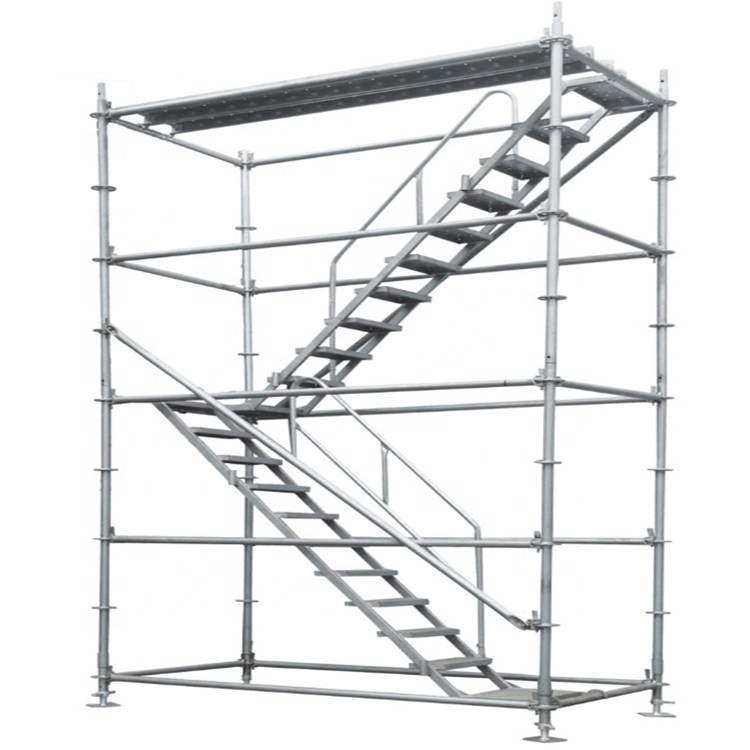
1. How the Ringlock Node Works (In 30 Seconds)
Ringlock gets its name from the circular rosette plate welded to every vertical standard at fixed intervals. Each rosette has eight keyhole slots, so horizontal ledgers, transoms and diagonal braces can be attached at any of eight directions (every 45°) using a wedge head that locks with a single hammer blow. No couplers, no bolts, no loose fittings.
- 8 connection points per node — more than any other modular system
- Captive wedge — cannot be lost on site, speeds up erection
- 500 mm rosette spacing on standards — the industry standard pitch
- Higher load capacity than cuplock — roughly 33% higher per standard in axial compression
For a side-by-side comparison with cuplock and kwikstage, including resale values and erection rates, see our ringlock vs cuplock vs kwikstage comparison guide.
2. Complete Ringlock Component List (2026)
Every ringlock system is built from the same core component family. The table below is the complete B2B checklist — use it to audit supplier quotations and build your per-bay bill of materials.
| Component | Function | Typical Spec |
|---|---|---|
| Standard (vertical) | Load-bearing vertical member with welded rosettes | 48.3 mm x 3.2 mm, S355, rosettes at 500 mm |
| Ledger (horizontal) | Connects standards horizontally, carries walkway loads | 48.3 mm x 3.2 mm, wedge ends both sides |
| Transom | Short horizontal spanning between ledger lines | Lengths from 0.73 m to 2.57 m |
| Diagonal brace | Lateral stability against sway | 48.3 mm tube, wedge ends, lengths to suit bay geometry |
| Base jack (adjustable) | Levels the scaffold on uneven ground | 38 mm threaded stem, 150-600 mm adjustment |
| Base plate (fixed) | Spreads load at ground level | 150 mm x 150 mm plate, welded stem |
| U-head jack (prop head) | Supports formwork and shoring loads | 38 mm stem, 150 x 150 mm U-channel head |
| Scaffold plank | Working platform | 220 mm wide, 1.0-3.0 m lengths, galvanized steel |
| Toe board | Edge protection at platform level | 100-150 mm high, clips to ledger |
| Guardrail post | Handrail support on top ledger | Fits rosette or sleeve-mounted |
| Stair tower components | Internal access stairs | Pre-assembled stair flights, 45° incline |
| Ladder | Alternative access | Fits rosette-mounted ladder brackets |
| Beam coupler / girder | Bridges over obstacles | Heavy-duty beams, engineered per project |
3. Standard Ringlock Dimensions (mm)
The table below lists the standard dimension range offered by Sino East Steel Group and most certified Chinese manufacturers. Always confirm the exact dimension set in writing — the rosette pitch and tube diameter are non-negotiable, while lengths can be customized.
| Parameter | Standard Value | Notes |
|---|---|---|
| Standard tube diameter | 48.3 mm | 48.3 mm x 3.2 mm for standards, 3.2 mm for ledgers |
| Rosette spacing on standard | 500 mm | Fixed industry standard |
| Standard lengths | 1.0 / 1.5 / 2.0 / 2.5 / 3.0 m | Half-metre increments standard |
| Ledger lengths | 0.605 / 0.907 / 1.209 / 1.511 / 1.813 / 2.015 m | Measured between rosette centres |
| Transom lengths | 0.73 / 1.09 / 1.45 / 1.83 / 2.57 m | Varies by bay width |
| Bay sizes (typical) | 1.5 m x 3.0 m (light) / 2.4 m x 3.0 m (heavy) | EN 12811 duty classes |
| Working platform height | Up to 60 m standard, 200 m engineered | With full bracing and tie-in |
4. Load Capacity Data
Load ratings are where suppliers differentiate — and where procurement mistakes are made. These are the 2026 reference values based on S355 steel and EN 12811 design assumptions.
| Load Parameter | Ringlock Value | Comparison |
|---|---|---|
| Ultimate axial capacity (48.3 x 3.2 S355 standard) | ~80 kN | Cuplock: ~60 kN (+33%) |
| Typical working load (light duty bay 1.5 x 3.0 m) | 2 kN/m² | EN 12811-1 Class 3 |
| Heavy-duty shoring grid | Engineered to 8+ kN/m² | Requires load tables per configuration |
| Component count per 100 m² facade | ~450 pieces | Cuplock: ~620 pieces |
| Erection rate | ~0.35 man-hours/m² | Kwikstage: ~0.40, tube & clamp: ~1.2 |
Important: published axial capacities are for a single unbraced standard in ideal conditions. Real projects must use the manufacturer’s engineered load tables for the specific bay size, bracing plan and duty class. Ask for the third-party test reports behind the load tables — a compliant manufacturer will provide them.
5. Steel Grade & Galvanizing Specifications
Two specifications determine the lifespan of your investment: steel grade and coating.
- Steel grade: specify S355 (Q355) for load-bearing standards and ledgers. Q235 is acceptable for secondary members but reduces capacity — never mix grades in load paths.
- Coating: hot-dip galvanizing to EN ISO 1461, minimum 55 microns average / 45 microns local. HDG ringlock lasts 15-25 years inland, 10-15 years in coastal environments. Pre-galvanized or painted systems last 4-8 years — false economy for export projects. See our hot-dip vs pre-galvanized analysis for the lifecycle cost data.
- Welding quality: manufacturer should hold ISO 3834-2 (welding) and EN 1090 (CE marking) — verify, don’t just accept the brochure claim.
5.1 How to Build a Per-Bay Bill of Materials (Worked Example)
One of the most common B2B mistakes is under-ordering components. Here is a worked example for a standard facade bay of 1.8 m x 3.0 m x 2.0 m high (one lift of a typical light-duty facade scaffold), so you can scale your own order:
| Component | Quantity per Bay | Notes |
|---|---|---|
| Standard 3.0 m (48.3 x 3.2, S355) | 4 | One at each corner |
| Ledger 3.0 m (face) | 4 | 2 per lift level (front and back) |
| Ledger 1.8 m (end) | 4 | Connects the four standards at each level |
| Transom 1.8 m (under platform) | 2 | Support for the working platform |
| Diagonal brace | 2 | One on each end bay for stability |
| Scaffold plank 1.8 m | 8 | Covers 1.8 m x 3.0 m platform |
| Base jack / base plate | 4 | One per standard |
| Guardrail post + toe board | 2 + 2 | Edge protection on the working lift |
Multiply these quantities by the number of bays and lifts in your project, then add 10% allowance for losses, site damage and dimensional adjustments — a standard practice in the industry that prevents mid-project re-ordering. If you are unsure how to scale, send the bay layout to your supplier and ask for a written BOM; Sino East Steel Group provides this free as part of quotation preparation.
5.2 Verifying Specifications on Delivery (Inspection Checklist)
What you inspect on arrival determines whether the delivered goods match the contract — and whether your certification survives a site audit. Use this checklist on every container:
- Rosette spacing: measure between rosette centres on random standards — must be 500 mm ± 2 mm
- Tube wall thickness: micrometer-check standards and ledgers — 3.2 mm, reject anything below 3.0 mm in load paths
- Coating thickness: magnetic gauge test — EN ISO 1461 requires 55 microns average, 45 microns minimum
- Weld quality: check rosette welds and wedge heads for cracks, porosity or incomplete fusion
- Wedge function: every wedge must seat fully into the rosette slot and lock with a single hammer blow
- Marking: standards should be stamped with manufacturer ID, standard reference and batch number — unmarked components fail EN 12810 traceability audits
- Mill certificates: verify the steel chemical composition and mechanical properties against your purchase order (S355 yield 355 MPa minimum)
Document everything with photos and a signed inspection report — this protects both parties and makes any insurance claim straightforward. A reliable supplier will also provide a pre-shipment inspection report with photos of your actual order before the container is sealed.
6. Container Loading Figures (B2B Planning Data)
Export buyers need to know how much ringlock fits in a container before they can compare FOB prices.
| Container | Ringlock Mix (approx.) | Typical Area Served |
|---|---|---|
| 20’ GP | ~18-20 tons mixed components | Small projects / spares |
| 40’ HQ | ~26-28 tons mixed components | Mid-size facade projects |
| 40’ HQ (planks only) | ~20-22 tons | Platform replacement |
| 20’ HQ (ledgers/transoms) | ~22-24 tons | System extension |
Loading density depends on the component mix — standards pack tighter than planks. Ask your supplier for a loading plan (with photos) before confirming the order. For the cost comparison between FOB, CIF and DDP on scaffold shipments, read our Incoterms guide for scaffolding buyers.
7. 2026 Market Price Reference (FOB China)
Based on August 2026 market levels for hot-dip galvanized ringlock from Chinese manufacturers:
| Specification | Price Range (USD/ton, FOB China) |
|---|---|
| Standards & ledgers, S355, HDG, 55+ microns | USD 1,100 - 1,350 |
| Transoms & braces | USD 1,050 - 1,250 |
| Planks (galvanized steel) | USD 1,200 - 1,500 |
| Accessories (jacks, base plates) | USD 900 - 1,100 |
| Full mixed container (40’ HQ) | USD 28,000 - 38,000 |
Prices move with steel coil costs and zinc prices — always request a written quotation with the specification locked in. Get an up-to-date quote for your project from the ringlock scaffolding product page.
8. B2B Procurement Checklist (Before You Order)
- Confirm rosette spacing (500 mm) and tube diameter (48.3 mm) in writing
- Require S355 for all load-bearing members, Q235 only for non-load parts
- Require EN ISO 1461 HDG, min 55 microns, with coating thickness test report
- Request certificates: EN 1090, ISO 3834-2, ISO 9001, EN 12810 test reports
- Ask for the engineered load table for YOUR bay size and duty class
- Get a loading plan with photos before shipping
- Verify MOQ (typically 1 x 20’ container) and lead time (usually 15-30 days after deposit)
- Check payment terms (commonly 30% T/T deposit, 70% against B/L copy)
Also review our scaffolding couplers buying guide if your project combines modular ringlock with tube-and-fitting elements.
9. FAQ
What is the standard rosette spacing on ringlock standards?
The industry standard is 500 mm between rosette centres on the vertical standard. Some manufacturers offer 400 mm or 600 mm on special orders, but 500 mm is the interoperable standard for EN 12810-compliant systems.
What diameter and wall thickness are ringlock tubes?
Standards, ledgers and braces are 48.3 mm outside diameter. Wall thickness is 3.2 mm for load-bearing standards and ledgers; some light-duty components use 2.7 mm or 3.0 mm, which reduces load capacity and should be avoided in primary load paths.
How much weight can a ringlock standard hold?
A single 48.3 mm x 3.2 mm S355 standard has an ultimate axial compression capacity of approximately 80 kN. In-service working loads depend on bay size, bracing and duty class — typical light-duty bays (1.5 m x 3.0 m) support 2 kN/m².
Can ringlock and cuplock components be mixed?
No. The connection mechanisms are fundamentally different — rosette-and-wedge vs cup-and-blade — and are not cross-compatible. Mixing systems within one scaffold bay creates a serious safety risk and voids certification. Use one system per independently designed structure.
What is the minimum order quantity for ringlock from a Chinese factory?
Most certified manufacturers, including Sino East Steel Group, accept a minimum order of one 20’ container (~18-20 tons). Smaller trial orders may be available but at a per-unit premium.
How long does it take to deliver ringlock scaffolding from China?
Production typically takes 15-30 days after deposit confirmation, plus shipping time (for example, 18-25 days to the Middle East, 25-35 days to Europe, 20-30 days to the Americas). Rush orders of standard components can be shipped in 7-10 days.
Why does ringlock cost more per ton than cuplock?
Ringlock uses fewer components per m² (~450 vs ~620 pieces per 100 m²) and assembles faster, but the rosette manufacturing process is more complex, pushing per-ton price 15-25% higher. On projects over 1,000 m², total installed cost is often equal or lower for ringlock.
10. Get a Specification-Locked Quotation
Sino East Steel Group manufactures ringlock to EN 12810/EN 12811 with S355 steel, EN ISO 1461 hot-dip galvanizing, and full documentation (mill certificates, coating reports, load tables). Send your project specification — bay sizes, duty class, quantity and destination port — and receive a written quotation within 24 hours.
Get a Ringlock Specification Quote
Tell us your bay sizes, quantity and destination port — a sales engineer replies within 24 hours.